Alibaba


In the hydraulic-braking era, grease played a relatively marginal role in the braking system. It reduced wear and suppressed squeal; when problems occurred, the worst-case outcome was merely “degraded pedal feel” or “one extra maintenance cycle.” But EMB has rewritten that logic.
EMB eliminates the hydraulic lines; the motor directly drives the ball screw to push the caliper. Friction fluctuations that were previously “absorbed” by the elasticity and damping of the hydraulic circuit now have no buffer layer and feed directly into the motor current and the control algorithm. Oudeli’s (ODR) assessment at an industry summit was straightforward: “In the hydraulic era, friction could be hidden; in the EMB era, friction fluctuations are amplified.” Grease is no longer merely “a material applied to friction pairs”—it has entered the control loop and become a variable that affects braking-force output precision, response speed, and system durability. When it comes to braking, there is no room for luck.
The First Capability: Stable Friction, Not “Low Friction”
Many people’s first instinct when selecting grease is to look for the product with the lowest friction coefficient. Is a lower friction coefficient always better? In EMB, exactly the opposite holds. The control system relies on a friction-compensation algorithm to ensure braking-force stability, and the prerequisite is that friction behavior must be stable and predictable. If the grease’s friction coefficient drifts continuously over long-term operation, the algorithm cannot compensate precisely, and the control precision of the clamping force declines accordingly.
Therefore, the key metric for EMB grease is not the initial friction value, but long-term friction stability. What bench validation must examine is not the friction coefficient at a single point in time, but whether the entire friction trend line still falls within a controllable range after millions of cycles. A drifting friction curve is far more dangerous than a slightly high initial friction value.
The Second Capability: Wide Temperature Range — Low Temp Looks at Current, High Temp Looks at Oil Film
“Low temp looks at current, high temp looks at oil film.” Oudeli summarizes the wide-temperature-range requirement in these eight words. EMB’s operating temperature spans from −40°C cold start all the way to sustained braking temperatures above 105°C: at low temperatures the grease viscosity rises, and the motor must draw a larger starting current to drive the screw, directly affecting response speed; at high temperatures the base oil bleeds out and the thickener structure degrades, and once the oil film breaks, wear becomes irreversible. If either end fails, EMB’s safety in extreme environments is compromised.
The Third Capability: Long-Term Durability — What Is Validated Is a Trend Line
EMB’s design target is typically “maintenance-free for life,” and bench durability standards are generally above 2.2 million cycles, with some validation systems demanding even more—certain tests are run at 4 million cycles. The real difficulty is not “completing the cycle count,” but whether the friction characteristics remain stable after completion. Changes in shear structure, base-oil bleed, and an oil film that cannot be rebuilt after repeated destruction all manifest as friction drift. In EMB applications, what grease must prove is not “how many times it withstood,” but “whether every actuation is predictable.”
The Fourth Capability: Material Compatibility — Grease Can “Contaminate” the System
Inside the EMB housing are densely distributed motor insulation layers, rubber seals (EPDM, HNBR), sensor protection layers, and engineering-plastic components. Improper grease formulation triggers not wear, but swelling, stress cracking, and even insulation failure. Sulfur and phosphorus compounds in traditional extreme-pressure additives can also corrode components, so EMB-specific greases must strike a balance between extreme-pressure performance and material safety. Sometimes, grease does not “wear out” the system, but “contaminates” it.
Four Scenarios — Not Something One Grease Can Solve
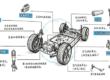
Four locations, one grease to rule them all? Definitely not feasible. The gearbox faces high-frequency meshing, moderate loads, low-temperature starting efficiency, and low-noise requirements; the thrust bearing withstands axial dynamic loads and switching shocks; the ball screw simultaneously experiences rolling and micro-slip with high contact stress, imposing the strictest demands on friction stability, high temperature, and durability; the caliper involves assembly lubrication, seal compatibility, and anti-seizure.
These four locations require different formulation strategies. Oudeli (ODR) provides a tiered solution for passenger-car and commercial-vehicle EMB:
ODR-CH641E: Does not swell or harden under long-term contact with EPDM, offers anti-wear and high load capacity with lifetime lubrication, and is suited to gearboxes, ball screws, and thrust bearings that use EPDM seals.
ODR-CKZ2606E: Used for EMB gearboxes, screws, and bearings; its synthetic oil provides good low-temperature fluidity and extremely low evaporation, is fully compatible with plastics and HNBR seals, and balances low-temperature efficiency with high-temperature durability.
ODR-C7003: Used for caliper-piston seal assembly, reducing friction and preventing damage, compatible with EPDM/SBR, rust-proof and anti-stick; guide-pin assembly is handled by ODR-C8003 / ODR-CW930.
The high-load commercial-vehicle scenario is covered by ODR-C608: a commercial-vehicle EMB specialist, shear-resistant and high-load-bearing.
The premise of selection is not “find a good grease,” but first confirm the seal material, operating temperature, and load spectrum, then match the corresponding grease.
From Supplier to Engineering Partner
The demands EMB places on grease have gone beyond the scope of “delivery to specification.” The friction characteristics of grease inversely define the compensation boundary of the control algorithm, and material compatibility directly affects the system’s long-term reliability. Grease companies must get involved at the system-design stage and jointly define the friction window, durability targets, and material boundaries with OEMs and brake-assembly manufacturers.
Oudeli’s industrial base supports this role transformation: Hecheng Oudeli (Zhongshan) operates a 20,000 m² intelligent workshop, a 17,000 m² R&D building, 8,000 tonnes of annual production capacity, and more than 40 invention patents; its EMB-specific greases have passed multiple rounds of bench validation. During the window when EMB moves from validation to mass production, grease is no longer a secondary material that can be “picked casually.” It is the most easily underestimated yet least ignorable link in the wire-controlled braking safety chain.
To learn more about EMB grease selection, please visit our website: https://www.odrgrease.com/
Grease—for an import alternative, choose Oudeli (ODR) of China!
Tel: 400-600-5867, 15859244196