Alibaba


Replacing the mechanical link between the steering wheel and the wheels with wires is the biggest change in steering systems since EPS became ubiquitous. At the intelligent chassis symposium in June, suppliers and OEMs were in rare agreement: steer-by-wire has moved from concept validation to scaled mass production, and four-wheel independent steering has opened up new room for imagination. With the GB 17675-2025 steering standard taking effect on July 1 this year, the last policy barrier to commercialization has also been cleared.
Three Steps, Starting with Decoupling
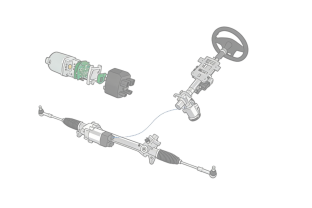
The evolution of steering systems is conventionally divided into five stages: the leap from hydraulic power assistance to electric power assistance around 2010, followed by more than a decade of refining the intelligence of EPS; the real qualitative change came in the last two to three years, with steer-by-wire reaching mass production. Today’s breakthroughs concentrate on three forms of decoupling: top-bottom decoupling, in which the rigid mechanical connection between the steering wheel and the steering actuator is removed and driver intent is transmitted electrically; left-right decoupling, in which the front and rear wheels can respond independently to control commands; and cloud-level integration, in which steering is deeply fused with braking, drive and suspension under the unified scheduling of a central controller.
Hurdle One: Redundancy and Degradation
Steer-by-wire generally uses dual redundancy, and some companies adopt a single-chip multi-core architecture with ample margin in both computing power and memory. Fault management is designed as a complete degradation chain: if the fault does not compromise safety integrity, the vehicle enters degraded mode and keeps driving; if safety integrity is compromised, the vehicle is brought down to a creep mode within a specified time; if lateral control capability is lost as well, rear-wheel steering assists in completing an emergency pull-over. Functional safety is defended along three dimensions: functional safety, safety of the intended functionality (SOTIF), and heterogeneous redundancy. Worth recording here: rear-wheel steering itself has been incorporated into the redundancy architecture of front-wheel steer-by-wire, an arrangement that raises the strategic standing of rear-wheel steering.
Hurdle Two: Is Rear-Wheel Steering Worth It?
Rear-wheel steering penetration is climbing, with industry data projecting overall fitment above 15% by 2027; the steady decline in cost from its early highs is the main reason. Application scenarios fall into four categories: comfort and convenience — low-speed agility and high-speed stability; stability and safety — split-friction compensation, crosswind disturbance rejection, understeer correction; ADAS coordination — automatic parking in extremely tight spaces and getting-unstuck assistance; and integrated control — deep coordination with steer-by-wire, ESC and the braking system. The consensus at the symposium: most models still rest on single-point functions, and the algorithmic headroom is still large for coordination with variable steering ratios, with ESC braking force distribution, and with ADAS path planning.
Hurdle Three: Backup Outside the System
Steering safety in the by-wire era is now considered at the level of the whole vehicle architecture. What if both redundant steering channels fail entirely? One OEM’s tests have supplied an answer: applying braking force on one side of the vehicle, combined with active rear-wheel steering intervention, still provides enough lateral acceleration under extreme failure to support an emergency lane change or a safe stop; differential torque output from the drive motors, combined with rear-wheel steering, can also complete a steering maneuver without relying on the steering gear. The boundary of this out-of-system backup capability is directly tied to the architecture of the chassis platform.
Further Ahead: Four-Wheel Independence
Four-wheel independent steering is the next qualitative leap: with all four wheels steered and speed-controlled independently, the constraints of conventional Ackermann geometry disappear, and compass turns, diagonal movement and pivot-in-place all become possible, directly rewriting the maneuverability of large vehicles. The supporting hardware is evolving too — long-travel electrically adjustable steering columns let the wheel be fully stowed in autonomous driving mode, taking cabin layout freedom up a level. With the mechanical link removed, precision requirements for the steering actuator rise across the board: motor bearings need low friction and low breakaway torque; rack and ball-screw mechanisms need low friction and high wear resistance to withstand high-frequency, short-stroke precision adjustments; and wheel-end integration pushes the wide-temperature requirement to -40 to 150°C. As localization accelerates, the window for domestic grease makers to co-develop with downstream partners is right now, in these next few years.
ODR Steering Lubrication Solutions:
ODR-CE16 screw / ball screw grease, -40 to 200°C, for steer-by-wire ball screws; extremely low friction, high transmission efficiency, resistant to fretting wear, compatible with engineering plastics.
ODR-CKZ2066 worm gear grease, -45 to 150°C, a lifetime maintenance-free solution for EPS worm gears.
ODR-CW70 rack-and-pinion grease, -40 to 130°C, stable shear resistance.
ODR-C5004 electrically adjustable steering column grease, -50 to 200°C, for long-travel columns, compatible with rubber parts.
Grease: for a drop-in replacement of imports, choose ODR from China!