Alibaba


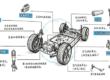
A car’s sense of refinement is something passengers feel first through the suspension. Three years ago, air suspension was the exclusive domain of million-yuan luxury cars; today, domestically produced NEVs priced around 300,000 yuan already feature it in large numbers. At the 2026 Changzhou Intelligent Chassis Seminar, OEMs and suppliers laid out this suspension technology roadmap in considerable depth. We have organized the discussion around the meeting’s content, and will also touch on how lubrication must evolve once the suspension changes.
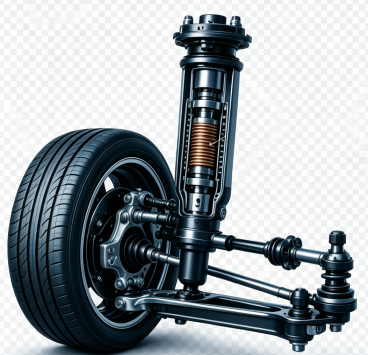
Three Generations of Technology, Two Parallel Paths
The industry divides suspension evolution into three stages. Passive suspension has stiffness and damping fixed at the factory—it transmits whatever force the road surface delivers, with zero means of control. Semi-active suspension operates along two dimensions: on the damper side, continuously variable damping, i.e. the CDC electronically controlled damper; on the spring side, adjustable height and stiffness, i.e. single- or multi-chamber air springs. The two dimensions combine freely and neither replaces the other; the dual-chamber air spring plus dual-valve CDC commonly seen in today’s mid-to-high-end models represents the top configuration of semi-active. Fully active suspension goes one step further, using an electro-hydraulic pump or electromagnetic actuator to directly output active force, achieving fully active control of body attitude. A certain leading new-force EV maker’s 800V fully active suspension, delivered at scale this past May, has officially brought this generation into mass production.
Fully active is not a new concept—it was previously held back by power supply. In the ICE era, the vehicle’s power supply could not support the energy demands of active suspension; only after the 800V platform and 48V systems of NEVs matured did fully active finally get on track.

Five Things the User Feels
At the seminar, a suspension lead from an OEM summed the user value of intelligent suspension into five points: no harshness—real-time damping and stiffness adjustment make rough roads feel like flat ground; no looseness—a strong sense of body unity, no wallowing over bumps; no floating—firm support at high speed, grounded feel maintained; full-scenario capability—raise the body for off-road, lower it for commuting, switch with one tap; personalized adaptation—the same vehicle learns different drivers’ preferences, offering a unique experience for each. Going one level deeper, a cabin as steady as a mirror is the physical foundation for a car’s transition from a mere means of transport to a mobile living space; working, dining, or watching videos in the car all rest on the premise that the suspension holds the jolts down.
Semi-Active Peaks, Fully Active Takes Off
This generation of semi-active configuration is essentially settled: dual-chamber air spring plus dual-valve CDC, paired with an active anti-roll bar. A technical expert on site said this combination is likely the most cost-effective solution for the future and has already been validated on multiple production models. The active anti-roll bar suppresses roll to an extremely low level, which is especially significant for large NEV SUVs.
The mass-production benchmark for fully active is a certain leading new-force maker: its new model comes standard with an 800V fully active suspension, directly eliminating the traditional stabilizer bar, fully decoupling the four wheels’ vertical motion, with per-wheel active force reaching 10,000 N. It shared a set of operating-condition data: at 120 km/h, during a high-speed lane change compounded by an outer rear tire blowout, the vehicle remained stably controllable. The dual-valve CDC supporting the fully active system delivers a rebound force of 8,700 N·m/s with a response within 25 milliseconds, specifically handling the high-frequency band.
Split or Integrated, and Where AI Fills In
Fully active hydraulic suspension currently follows two architectures: split type, where the pump and damper are separated and connected by lines, achieving ceiling-level low-frequency large-posture control but with a relatively long response chain; integrated type, where pump and damper are one unit, compact in structure but limited in high-frequency isolation. The two routes each have trade-offs, and for now there is no overwhelmingly superior solution. The trickiest part of control is phase matching: the active force must be in-phase with road excitation; a half-beat late, and the active force instead aggravates the harshness. Hence the current division of labor is for the active suspension to focus on the mid-to-low frequencies below 2.5 Hz, while the high-frequency band is handed to CDC, with the two coordinated precisely.
The consensus on bringing AI into suspension is also pragmatic: rule-based control ensures safety, while AI handles the part that rule-based control does poorly. Ride comfort is a subjective feeling that mathematical models cannot characterize accurately, so this segment is handed to AI to push the boundaries within a rule-constrained framework. A step further is feedforward pre-tuning—using cameras and LiDAR to read the road ahead, adjusting the suspension before reaching a speed bump. Vehicle-cloud coordination is also under trial; the engineering trade-offs of latency alignment, data volume, and communication cost still need to be worked out, so deployment won’t be quick.
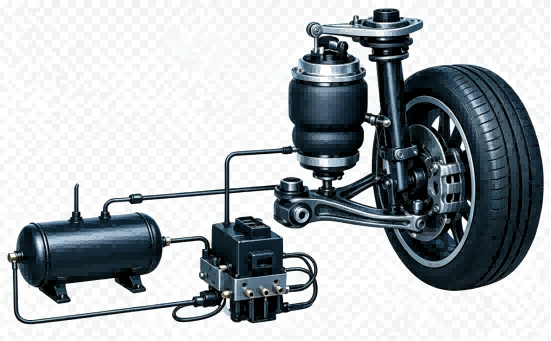
As the Suspension Changes, So Does the Lubrication Strategy
As suspension moves from passive to fully active, the idea of one general-purpose grease ruling them all no longer works. In traditional dampers, pistons and valve systems reciprocate at high frequency, requiring long-life greases that resist wear and shear. With CDC plus solenoid valve actuators delivering millisecond-level response, the oil-film build-up speed and adhesion under repeated start-stop directly affect the control precision of the valve system. The lubrication focus of air springs is on the air supply unit; the bladder itself is not the issue—leading companies’ precision-woven bladders are already under 2 mm thick: the compressor piston undergoes frequent high-pressure charge/discharge start-stop, and the precision valve faces must coexist long-term with rubber seals. The fully active electro-hydraulic pump is even more demanding: the grease must coexist long-term with high-pressure oil without emulsifying or diluting, and must also withstand the high temperature and extreme pressure brought by high-frequency operation.
ODR: An Integrated Lubrication Solution for the Intelligent Chassis
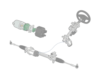
Over the years, ODR Grease has continuously participated in discussions on intelligent chassis new technologies as well as on industry-association and national standards. Along three directions—braking (X), steering (Y), and suspension (Z)—we collaborate with numerous domestic R&D institutions focused on the various subsystems of the intelligent chassis, taking part in product development and grease compound selection. We have also invested in a ball-screw test bench, working with multiple OEMs and R&D institutions to validate the durability and performance of greases on ball screws. From braking and steering to suspension, ODR has successfully validated a professional lubrication solution covering the entire intelligent chassis system.
ODR Grease’s suspension portfolio maps to four specific grades.
ODR-CU2744 damper polyurethane-slider assembly grease: rated −50~150°C, compatible with polyurethane without swelling, resistant to water spray and mud abrasion;
ODR-C704F fluoro-grease for the air spring air-supply unit’s piston rings, valve plates, and bearings: rated −65~260°C, resistant to oil-gas mixed conditions, with good chemical inertness;
ODR-CY921 for the active anti-roll bar’s reduction gears: rated −40~180°C, withstands frequent forward/reverse operation, low starting torque, noise reduction;
ODR-CZ2874 for ball joints and control arms: rated −40~150°C, extremely high load capacity, water-spray and corrosion resistant.
For supporting solutions for the fully active electro-hydraulic pump, we welcome you to bring your operating conditions to find the corresponding product.
For grease, choose Chinese ODR as your import substitute!
I’m Lao Zhou from the grease world, focused on the application practice of specialty greases in automotive chassis systems.