Alibaba


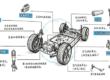
The race for the intelligent chassis has officially entered the domain-controller fusion stage this year. The four subsystems—drive, brake, steering, and suspension—are moving from working in isolation to operating under unified command, as the chassis shifts from hardware stacking to system-level integration. At the Changzhou Intelligent Chassis Symposium this past June, test data on this topic was the densest of the event; here I distill the substance for you.
A Three-Step Architecture Roadmap
The industry roadmap is clear: In Phase 1, the chassis domain and the powertrain domain merge into a “motion domain,” achieving coordinated control across the three axes—X (longitudinal acceleration/deceleration), Y (lateral handling), and Z (vertical ride comfort). In Phase 2, the intelligent chassis and the ADAS domain are linked bidirectionally to close the perception–decision–execution loop, what the industry calls “unity of knowing and doing.” In Phase 3, large AI models become fully involved, and the chassis evolves from merely satisfying functions to intelligent self-evolution. The communication backbone is also being replaced: the 1 Mbps bandwidth of the CAN bus cannot support multi-domain fusion, so leading companies have moved to full Ethernet ring networks with bandwidth reaching the Gbps—even 10 Gbps—level, dramatically simplifying the vehicle’s wiring harness.
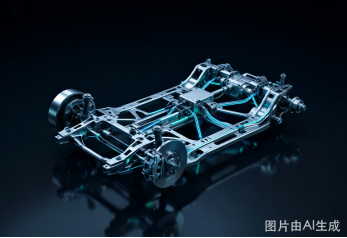
Drive–Brake Fusion: 100 Milliseconds Saved
In the traditional architecture, the e-drive and hydraulic braking must be arbitrated through the VCU via pass-through, making the chain long-winded. Under the fused architecture, a single motion-domain controller arbitrates and allocates commands, issuing instructions to both the VCU and the EMB simultaneously and eliminating the pass-through step—shortening the response chain by over 100 milliseconds. At the symposium, a leading tech company shared a set of real-world measurements: with identical hardware, architecture optimization through drive–brake coordination alone shortened braking distance on slippery roads by 15%. The logic is that a local closed loop identifies tire slip ratio in real time and pushes adhesion to its physical limit; the gain from fused control comes from the control architecture itself, not from piling on more hardware.
The X-axis is the most critical fast-control dimension. Data from experts at the symposium: the X-axis (drive, brake) control frequency is 200–1000 Hz, while the Y-axis (steering) and Z-axis (suspension) are around 20 Hz. Roughly 90% of dangerous scenarios can be resolved by X-axis drive–brake coordination alone; when X-axis capability is maxed out and still insufficient, the Y and Z axes engage simultaneously to push the vehicle’s performance envelope outward. The progress in eTCS is striking: a traditional TCS relies on a wheel-speed-sensor closed loop with a slip-identification cycle of about 50 ms; the fused architecture detects directly via the motor resolver, cutting that to 2 ms, with a local closed-loop control period of 1 ms. C-ABS—a fused electro-braking anti-lock system—delivers an average braking deceleration about 0.3 G higher than EMB alone, with a TTL response of 40 ms.
Three Forms of the Motion-Domain Controller
There are three typical forms: a standalone motion-domain controller with clear interfaces and well-defined roles, used on high-end platforms; deep integration of the motion domain with the VCU, saving one controller, used on mid-range models; and high integration of the motion domain with actuator control, offering the shortest link and high chip reuse—though common-cause failure risk here requires dedicated design. In the long run, the ADAS domain and the motion domain will eventually merge: the vehicle’s AI “brain” plus a motion “cerebellum” is the ultimate form for high-level autonomous driving.
Unity of Knowing and Doing: The Chassis Must Report
In the past, about 60% of ADAS disengagement scenarios were triggered by chassis actuators such as the ESP. Under the fused architecture, the chassis domain and the ADAS domain share perception and plan in unison—the ADAS is responsible for “knowing” and the chassis for “doing.” The key change is in the data flow: the motion-domain controller estimates each system’s operating boundary in real time and feeds its capability ceiling back to the ADAS, so the ADAS knows how much force it can use rather than issuing blind commands and then being forced to disengage. At the symposium, a company summarized this as the chassis needing the ability to “speak up”: reporting in real time the current risk level, steering limit capability, and braking conditions. Perception is the biggest bottleneck in current cross-domain fusion; capabilities such as multi-source fusion identifying road adhesion coefficient 300 ms earlier with 50% higher accuracy directly determine how far the ADAS operational design domain can be expanded.
The software side has its hard metrics too: SOA layered decoupling, where replacing an actuator only touches the device abstraction layer while upper-layer applications remain unchanged; a braking-control response period no longer than 5 ms; functional safety at ASIL D for braking and steering and ASIL B for suspension; and a hybrid AUTOSAR Adaptive + Classic deployment. OTA lets chassis functions keep evolving—features like brake judder suppression and curve vectoring control can already be pushed remotely. Digital twin currently focuses mainly on actuator-level and system-level virtual verification; for example, accelerating the durability testing of a ball screw—model first to predict, then verify on a test bench to correct parameters, advancing on both the virtual and real fronts.
The Lubrication Challenge in the Domain-Controller Era
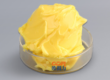
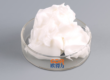
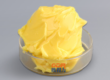
Domain control packs many different actuators into a single chassis: EMB brake motors, steer-by-wire motors, active-suspension hydraulic pumps, and drive motors—each with different speeds, loads, and duty cycles, so the lubrication scheme must be customized point by point. The EMB caliper is space-constrained, with instantaneous braking temperature rise exceeding 200°C; the active-suspension hydraulic pump operates at high-frequency reciprocation, demanding strong resistance to fretting wear; and the motor bearings on 800V platforms add two new requirements—electrical insulation and low-impedance thermal conduction. Under the premise of full-life maintenance-free operation, the reliability of the grease is directly tied to overall vehicle safety. Domestic greases have been catching up fast in recent years in base-oil refining, additive formulation, and thickener structure; the capability base for substitution is already in place. What is lacking is the validation data built up alongside the actuators—and Oudeli (ODR) Grease has been continuously testing and tracking this, providing complete lubrication solutions for braking, steering, and suspension.
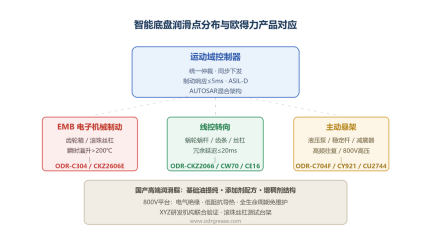
Oudeli’s matching products across the braking, steering, and suspension segments can be combined directly:
For EMB gearboxes and ball screws, use ODR-CH641E (−45 to 180°C), compatible with EPDM seals; ODR-CKZ2606E (−40 to 150°C) and ODR-C304 (−40 to 180°C) are compatible with HNBR seals; for steer-by-wire ball screws, ODR-CE16 (−40 to 200°C, low friction, anti-fretting wear); for active stabilizer-bar actuators, ODR-CY921 (−40 to 180°C, withstands frequent forward/reverse operation); and for damper polyurethane slider assembly, ODR-CU2744 (−50 to 150°C). One validated data chain serves multiple actuator types—this is where supplier consolidation begins to pay off.

For specialty grease, choose Oudeli (ODR) of China as your import alternative!
I’m Old Zhou from the grease world, focused on the practical application of specialty lubricating greases in automotive chassis systems.